Turn unreadable code into
a handover-ready asset.
AI builds a first draft in 1–2 hours. Then a dialogue surfaces your team's tacit knowledge to finish it together.
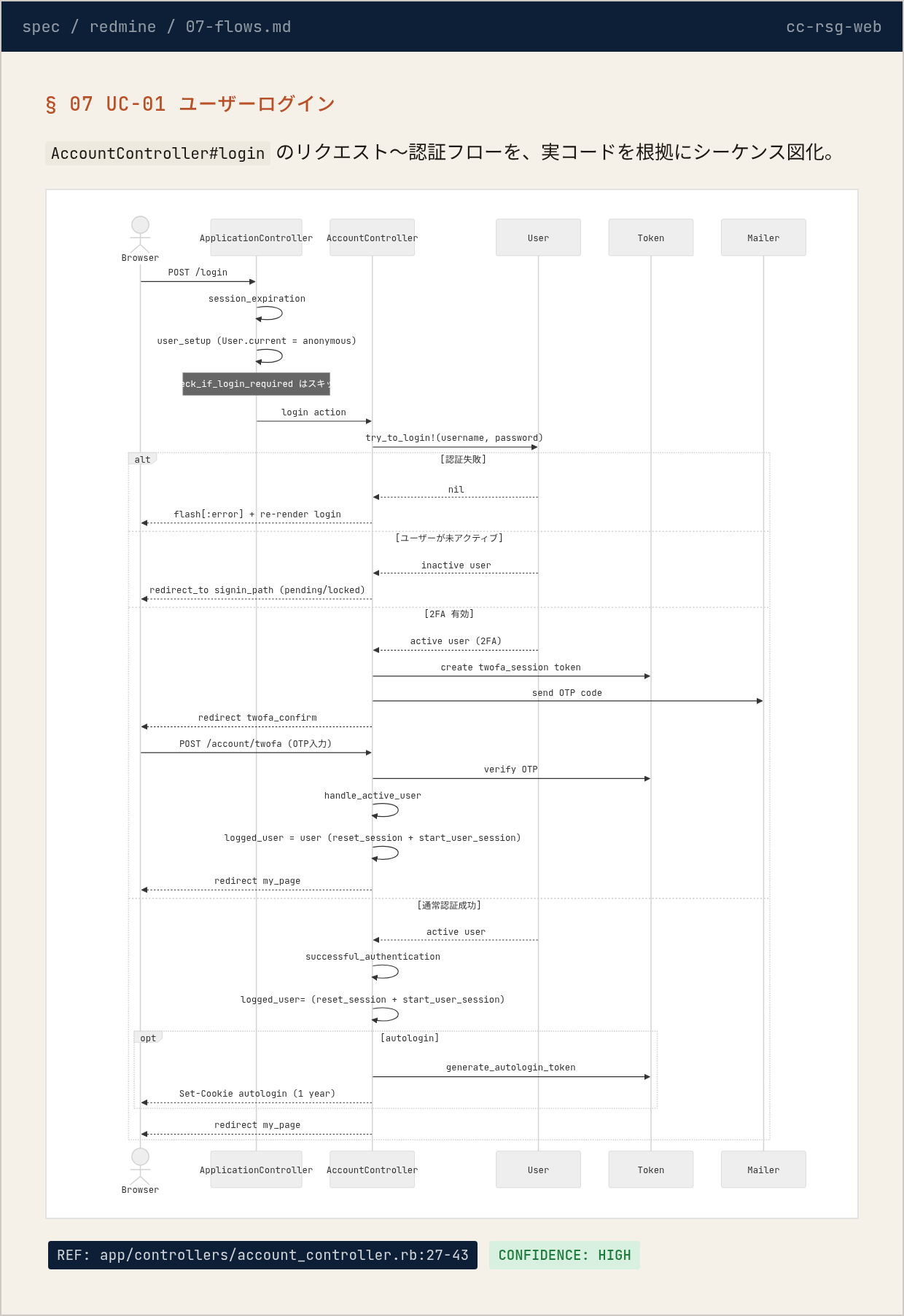
▲ A spec cc-rsg-web actually generated (from the Redmine proof). With Mermaid diagrams and REF citations. Shown in Japanese.
The trouble with specifications
Six scenarios that keep happening on the ground.
No spec was ever written
The original docs are unreliable; only the code remains. Nobody knows what to change, or how.
The original author has left
"Only one person knew why it was designed that way." But that person is long gone.
Handovers stall
Some details can't be conveyed verbally, and the successor has no time to decode the code alone.
Maintenance effort stays high
Without the big picture, maintenance is guesswork. Just checking impact eats most of the effort.
Audits can't start
"Please submit the specifications." But there's no grounded document to hand over, so the audit stalls.
Rebuild budgets get rejected
You face the approval meeting unable to explain the current system's size and complexity.
Reading the code alone won't tell you. People's memory is the real asset — a reality only the field knows.
How cc-rsg-web solves it
"AI drafts it," "dialogue deepens it," "finish together" — we work alongside your team, growing the spec together in three steps.
Auto-generate the first draft
It scans the codebase and assembles a first draft in 1–2 hours — chapter structure, ER and sequence diagrams, and source REF citations. That said, it's a starting point for dialogue, not a finished product.
- Full codebase analysis
- Auto chapter structuring
- ER / sequence diagrams
- Source REF citations
Surface tacit knowledge with focused questions
For each chapter, we interview your team — "why this design decision?", "what's the history of this exception handling?" — learning from you and reflecting your answers into the draft as we dig deeper together.
- Ask anywhere
- Answers flow into the text
- Design decisions recorded
- Consensus-based review
Established as an org asset
The finished spec keeps reverse references (REF) to the source throughout. When code changes, you can trace which chapters need updating.
- REF kept throughout
- Linked to code changes
- Markdown / PDF export
- Incremental updates
The key to using AI well is phasing. The AI runs analysis and generation automatically, while Phase 0 (goal definition) and Phase 5 (dialogue) reflect your intent and domain knowledge through interviews with your team.
← scroll · tap to zoom →
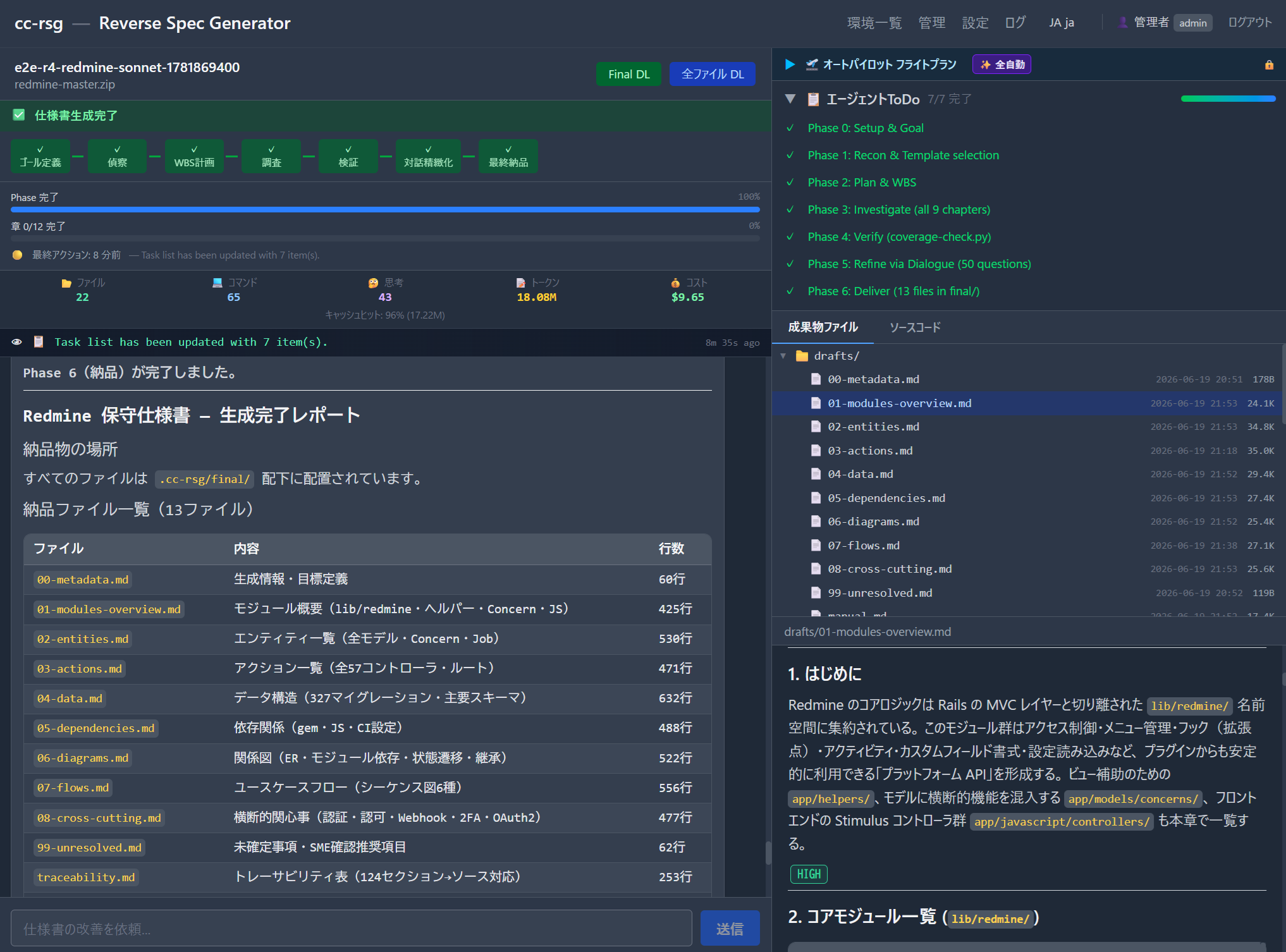
Proof of concept: Redmine
We analyzed the entire large OSS "Redmine" and auto-generated a 13-chapter spec with Mermaid diagrams and REF citations. Click a chapter to browse part of the actual output (shown in Japanese — cc-rsg generates in the target language).
⤢ Tap a chapter for full screen
※ Excerpts from a spec cc-rsg-web actually generated (Redmine / Sonnet), shown in Japanese as the real output. Mermaid diagrams, REF citations and confidence markers are kept as-is. This is a first draft that becomes an org asset through dialogue.
Why neither "AI alone" nor "humans alone" works
Comparing three approaches across six axes.
→ scroll horizontally
| Axis | Manual | AI dump | Our service (hands-on support) |
|---|---|---|---|
| Time | Weeks to months | Hours | 2–3 days |
| Accuracy | High | Low (hallucinations) | High (REF-verified) |
| Tacit knowledge | High (person-dependent) | Impossible | High (via dialogue) |
| Traceability | Low (manual) | None | High (full REF) |
| Cost | High | Low | Moderate |
| Keeps up with changes | Low | Impossible | High (REF diff) |
Related preprints (2)
A Phased Co-Construction Methodology for Reverse Specification Generation: Why AI-Native Documentation Requires the Human
Hirashima, Daishiro (Toyo System Co., Ltd) · Preprint · 2026
It includes the design philosophy, evaluation metrics, and empirical data, written so third parties can verify the methodology. This site's approach is based on this preprint.
Measuring Reverse-Specification Quality Without Ground Truth: A Three-Layer Framework and a Pre-Registered Study of Scale-Induced Failure Modes in Autonomous Coding Agents
Hirashima, Daishiro (Toyo System Co., Ltd.) · Preprint · 2026
A ground-truth-free, three-layer framework for measuring reverse-specification quality, with a pre-registered study of scale-induced failure modes in autonomous coding agents. The evaluation companion to cc-rsg. English and Japanese editions included.
Use cases
Where cc-rsg-web makes a difference.
Before a core-system rebuild
"We want to modernize a 20-year-old core system, but we must first grasp the current spec."
Generate a draft from the code and document the current spec through dialogue. Greatly shortens RFP preparation.
Audit response
"An ISMS / SOC 2 review asked us to submit system specifications."
Quickly prepare a spec with REF evidence — support for answering exactly what auditors ask.
Handover from an overseas subsidiary
"HQ is taking over a system built at an overseas site."
Auto-generate a spec from the foreign codebase and integrate interviews with local staff.
Post-M&A PMI
"We need to understand what's inside the acquired company's systems."
Analyze the acquired code and visualize duplicate features, integration risks, and dependencies as a spec.
Evaluating OSS before adoption
"We want to understand the internals before embedding OSS in our business."
Generate a focused spec from the OSS code and document the customizable scope and caveats.
Before splitting into microservices
"We want to split the monolith but don't know where to draw the boundaries."
Organize module dependencies and data flow as a spec, and discuss split boundaries on solid ground.
Answers to security & operational concerns
We answer the concerns we hear most, up front.
Frequently asked questions
A hands-on, quasi-mandate engagement
Rather than one-sidedly delivering a finished product, we grow the specification together with your team, learning your context as we go. We provide professional services with due care (not a build-to-completion contract).
From your running code and your team's heads —
shall we build the spec you truly need?
Reach out anytime. We'll propose an approach and a quote tailored to your codebase.
Tell us about your target system via the contact form (Microsoft Forms) below. We'll review it and a representative will get back to you.
✉ Open the contact formOpens on forms.cloud.microsoft (new tab)
Acknowledgements & open source
This site, "cc-rsg-web," is built on the open-source reverse-spec-generation skill cc-rsg. Its design philosophy, implementation, and operational know-how are published in the repository and article below. With gratitude to the OSS community, we give back what we learn, both inside and outside the company.